

Explosive increase in Chinese war capacity — China's silent surge across seas closes gap with the US and turns global balance of power upside down
China is closing the naval power gap with Washington at rapid speeds, raising intense concern among Western military analysts after outpacing the United States by more than double in warship tonnage production during the two-year period 2024–2025, according to a new international report. The World Defense Shipbuilding report, authored by the French organization Flottes de Combat and the naval industry association Gican, reveals that China constructed approximately 636,208 tons of warships over two years up to December 2025, at a time when the US produced merely 270,509 tons in the same timeframe. China now accounts for more than one-third of global naval capacity constructed during the 2024–2025 biennium, while in economic value terms, Chinese warship production reached $43.5 billion, compared to $26.8 billion for the US. Simultaneously, data demonstrates a clear surge in Chinese production compared to the previous biennium, confirming the momentum of the Asian superpower.
Beijing closes total displacement gap
Although the American Navy still retains leadership in total fleet displacement, the distance is shrinking by leaps and bounds. On January 1, 2026, American warships over 200 tons concentrated 3.11 million tons, compared to 1.44 million tons for China, whereas barely two years earlier corresponding figures stood at 3.22 million tons for the US and 1.3 million tons for China. Concurrently, China has already overtaken the US in total unit numbers, possessing more than 370 battle-line ships versus approximately 290 for the US Navy, with forecasts by American defense institute CSIS estimating the Chinese fleet will reach 425 ships by 2030, at a moment when the US will possess around 300 units.
Dual-pronged strategy using numbers and size
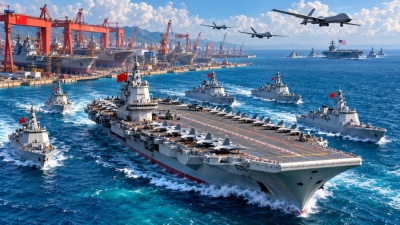
Adding displacement is distinct from the simple production of small craft, as larger displacement translates into more weapons, sensors, fuel, aviation assets, and greater operational autonomy in the battle theater. China now applies both tactics simultaneously, as it accelerates the construction of smaller surface units while concurrently building massive, sophisticated units, such as the Type 003 Fujian aircraft carrier, Type 055 destroyers, and Type 075 amphibious assault ships, with the obvious objective of achieving full operational readiness for its navy in future conflicts.
Military-Civil Fusion policy as driving force
Beijing's capacity to surpass the US does not rely exclusively on purely military shipyards, but on the country's gigantic commercial shipbuilding industry and massive economies of scale. State giant China State Shipbuilding Corporation (CSSC) constitutes the paramount example of this full integration, as in 2025 Chinese shipyards produced 53.69 million tons of commercial vessels, covering 56.1% of global production and concentrating 66.8% of the global order book. International dependence on Chinese commercial shipyards channels massive revenues that are reinvested into military shipbuilding.
Shared infrastructure and the gigantic supply chain
Warships and commercial vessels are constructed side by side in the same dry docks and slipways at massive shipbuilding complexes such as Shanghai Changxing, Dalian, and Longxue, a reality corroborated by satellite imagery. This dual usage sustains hundreds of thousands of specialized welders, engineers, and technicians who are directly transferred to defense programs according to operational needs, while mass production drastically reduces unit costs and secures robust domestic supply chains for steel, electronics, engines, and radar systems.
US qualitative edge and resort to allies
Despite the numbers, the US retains significant qualitative advantages, such as 11 nuclear-powered aircraft carriers, a superior fleet of nuclear submarines, larger missile capacity per vessel, and vast combat experience. However, due to delays, bureaucratic bottlenecks, and labor shortages in American shipyards, Washington is now turning to the shipbuilding expertise of its close Indo-Pacific allies, such as South Korea and Japan, for vessel maintenance and construction in order to stem rapid Chinese expansion before the balance of power is permanently lost.
www.bankingnews.gr










Σχόλια αναγνωστών